
Rental property maintenance in Cape Town is what separates one managing agent from another, and the right choice depends on your time, distance and volume. Most landlords judge an agency on the day the lease is signed. They should judge it on the day the geyser bursts.
The job itself is rarely difficult. The risk is that it gets lost: a WhatsApp here, an email there, a contractor who was never told, and a tenant who reports the same leak three times before anyone acts.
On this page
- Three ways to handle rental property maintenance
- The problem a tracked system solves
- The seven steps a job moves through
- What that means for you as a landlord
- Inspections, simplified
- Why I built it rather than bought it
- How to choose: what to ask any managing agent
- Frequently asked questions
Three ways to handle rental property maintenance
There are really only three, and each one costs you something different.
- Manage it yourself. Cheapest in fees, most expensive in time. It works if you own one property, live near it, and can take a call at four on a Friday. It stops working the moment you are away, or the moment a tenant needs an answer you cannot give from memory.
- An agency that runs maintenance off email and WhatsApp. The common arrangement, and fine until volume arrives. The weakness is not effort, it is recall: nobody can hold thirty open jobs in their head, so the quiet ones drift. You usually find out when the tenant escalates.
- An agency that runs maintenance on a tracked system. Every job logged, statused and dated, with the owner deciding before anything is instructed. It costs a management fee and it removes the chasing. This is what we do, and the rest of this article is exactly how it works.
The honest trade-off: option one is not wrong for a single property next door. Options two and three cost the same fee. The difference is whether anyone can tell you, in ten seconds, the status of every open job at your property.
- Every maintenance job goes into one place, the moment it is reported.
- Every job is linked to the property’s file, so its full history stays together.
- Every job has a status, a contractor and an expected completion date, and anything running late is flagged.
- Nothing is instructed without the owner’s agreement, and nothing is closed until the work is confirmed done, with photographs.
- Inspections are done on a phone, and the report and photos file themselves.
The problem a rental property maintenance system has to solve
In a busy agency the danger is not laziness. It is volume. Spring and the end of winter bring a rush of jobs across Rondebosch, Claremont and Constantia: the gutter that overflowed in July, the damp patch, the gate motor, the geyser on its last legs. Across a whole portfolio that is a lot of moving parts, and memory is not a system.
Before, a maintenance request could live in someone’s inbox, someone else’s phone and a note on a desk. Now it lives in one place, and the whole team works from the same list.
The seven steps a job moves through
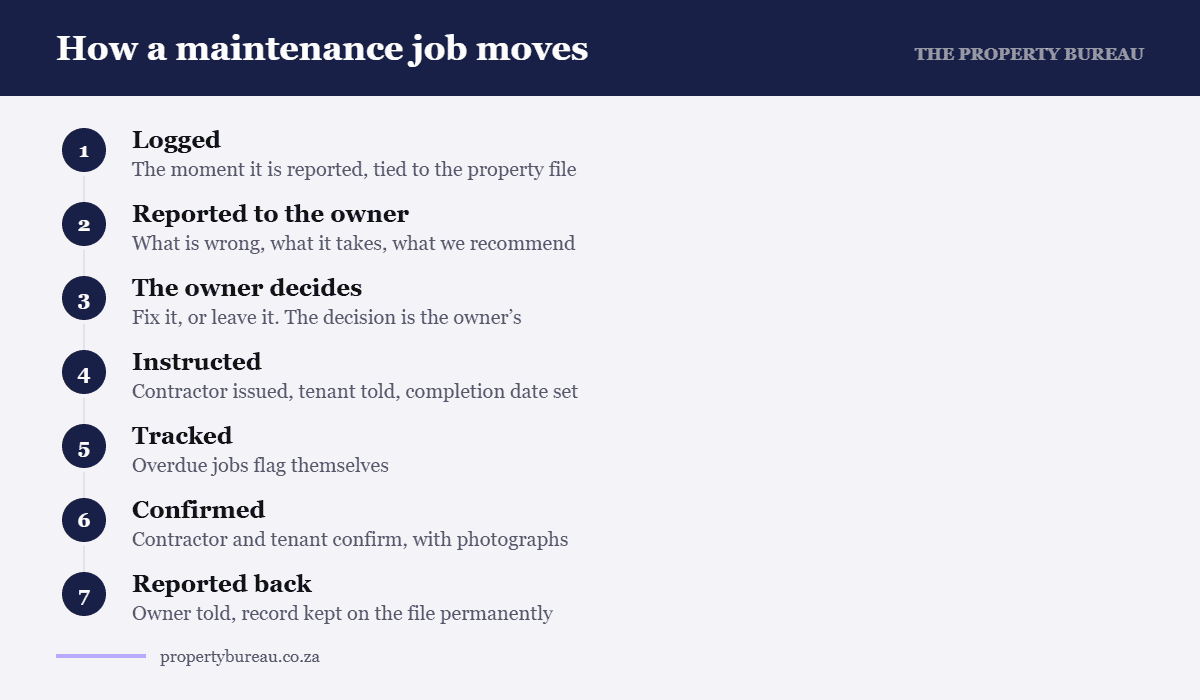
The order matters, and one step in it is the one landlords care about most: nothing is instructed until the owner has agreed to it.
- Logged. When a tenant or landlord reports a problem, the team logs it straight away. It takes about a minute. The property’s file code pulls up the address, so the job is tied to the right property from the start.
- Reported to the owner. We tell the owner what has gone wrong, what it will take to put right, and what we recommend.
- The owner decides. Go ahead and fix it, leave it, or “I will put it through insurance and keep you posted”. It is the owner’s property and the owner’s money, and the decision sits with them.
- Instructed, once we have agreement. The contractor is given the job and the detail, with the date it was issued and when it should be finished. The tenant is told at the same time, so they know who is coming and when. Nobody is left wondering whether anything is happening.
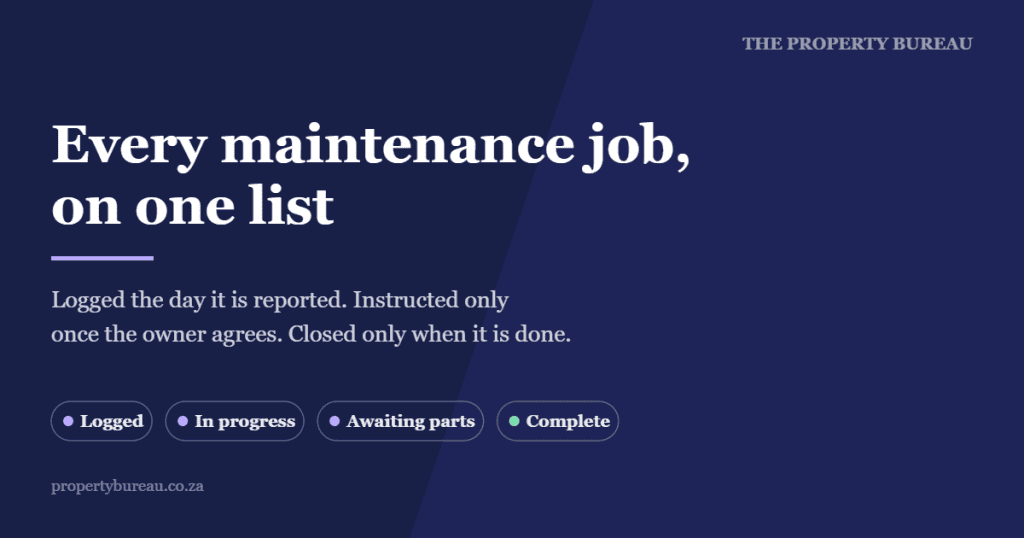
- Tracked. Every job carries a status: Logged, In Progress, Awaiting Parts or Complete. If the expected completion date passes and the job is still open, it shows as overdue.
- Confirmed. We close a job when the contractor confirms the work is done and the tenant confirms it too, with photographs. Not when somebody says they will get to it.
- Reported back to the owner. The owner hears that the job is finished, and the whole record stays on the property’s file permanently.
What that means for you as a landlord
- A full history of your property. Because every job is linked to your property’s file, we can see what has been done, when and by whom. That matters when you are budgeting, when a problem comes back, and when you eventually sell.
- Nothing falls through the cracks. An open job cannot quietly disappear. It either moves forward or it shows as late.
- A straight answer when you ask. When you want to know where a repair stands, the answer is on the screen, not in somebody’s memory.
- Problems caught before they grow. A damp patch dealt with in winter is a paint job. Left alone it becomes a plaster job, then a health complaint, then a deposit dispute at the Rental Housing Tribunal.
It is not only maintenance
The same system now runs the rest of our day to day. Urgent matters that need me to phone an owner or a tenant are logged and reach me in a summary every working afternoon, so nothing depends on me remembering a hallway conversation. Leases coming to an end and inspections falling due are flagged ahead of time, and every Monday I get a short scorecard of open jobs, overdue jobs and what was completed that week.
Inspections, simplified
Inspections used to be the most laborious job in the office. Clipboards, handwritten notes, photos scattered across a phone, and then an evening typing it all up into a report. It was slow, and slow work gets put off.
Now an inspection is done on a phone, on site, and the report is finished when the inspection is.
- Pick the template. One, two, three or four-plus bedrooms, and the checklist builds itself room by room, from the entrance and kitchen through to the geyser, the electrics and the garden. Extra rooms, en-suites and outbuildings can be added in a tap.
- Tap through each item. Good, needs attention, to clarify, or not applicable. Anything flagged opens a comment box so the detail is captured there and then.
- Photograph as you go. Photos attach to the item they belong to, not to a camera roll that has to be sorted later.
- Nothing is lost. The inspection saves on every tap, so a phone call or a flat battery halfway through costs nothing.
- Sign and finish. The tenant can sign on the screen, meter readings are recorded, and the report is produced on the spot, with the items needing attention listed first.
- Filed automatically. The finished report and the full-resolution photos go straight into that property’s folder. Nobody has to remember to save them.
What the system does not do is make the inspection quick. Going through a property properly still takes real time on site, room by room, and it should. The app removes the paperwork afterwards, not the work itself. Some agents enjoy inspections, others do not, and that is usually a fair measure of who is thorough.
That is the point of doing it properly. Section 5 of the Rental Housing Act 50 of 1999 requires the landlord and tenant to inspect the dwelling jointly before the tenant moves in and again at the expiration of the lease, and a landlord who does not is deemed to have accepted that the property is in a good and proper state of repair. So when there is a question about condition at the end of a tenancy, the answer should be a dated report with photographs, filed against the property, not somebody’s recollection.
What it is not
It is not a landlord portal. You do not need to log in to anything, and I would rather you did not have to. You still deal with us directly, and we keep you informed. The system is there so that when we tell you something, it is accurate.
It also does not replace judgement. It tells us what is open and what is late. Deciding what a repair should cost, and whether a contractor has done it properly, is still our job.
Why I built it rather than bought it
We are in the age of system support and system management. An agency that still runs rental property maintenance off WhatsApp threads and memory is carrying a risk it cannot see until something goes wrong.
Our primary focus is removing friction: for our clients, for landlords, for tenants, for my team, and for me. Every step that has to be chased, repeated or remembered is friction, and friction is where things go wrong. This system removes a great deal of it, and that is what makes the management side of our business manageable.
I looked at what is on the market. Most property software is built for large agencies, priced for them, and loaded with features a medium-sized team will never use. Adopting it would have meant changing how we work to suit the software. I wanted the opposite: something simple, accurate and shaped around how a real rental team works, where each thing is entered once and used everywhere.
Simple does not mean basic. We now handle hundreds of maintenance jobs a month, and the system carries that volume without strain. It is not clever for the sake of it. It is accurate, and accuracy is all I am interested in. It keeps everybody on their toes, because an open job cannot hide.
The reason we run the rental side of the business well is systems like this. Everybody knows their role. When there is a problem, there is somebody to help. And the facts are on the system, not in somebody’s head.
Not every day is peachy. But we have a lot more peachy days than not. It is also how we are built on purpose. A strong back office carries the day to day, so the people in the field can stay in the field.
For other agencies
It has proved so fit for purpose, and made such a difference to our day to day, that we are now making it available to other agencies. It was built inside a medium-sized agency, for agencies like ours, but because it is simple and accurate rather than complicated it works for an agency of any size that is serious about proper rental management. Each agency runs its own separate copy, set up around its own properties, team and way of working.
If you run an agency and want to see it working, get in touch and I will walk you through it.
How to choose: what to ask any managing agent
Whether you use us or somebody else, these four questions separate a tracked operation from a hopeful one. Ask them before you sign a mandate.
- “Show me every open job at my property right now.” If the answer arrives as a list with dates and statuses, good. If it arrives as “let me check with the team”, that is your answer.
- “Who approves a repair, and at what value?” The right answer is that you do, except for genuine emergencies. Anything else is somebody spending your money on your behalf.
- “How do you close a job?” Confirmation from the contractor and the tenant, with photographs, is the standard. A contractor’s invoice on its own is not proof the work was done properly.
- “Can I see the maintenance history for the last three years?” If the history lives in an inbox, it does not really exist, and you will feel that when you sell.
That is the whole approach in one line: one list, every job on it, and nothing closed until it is done.
If you want your property looked after this way
If you are managing a rental yourself, or you are not sure your current agent could tell you the status of every open job at your property, a free 30-minute Mandate Review will give you a straight read. We manage at 11.5% of monthly rent collected, fully inclusive, with no extras, run personally by a PPRA registered Property Practitioner. More for landlords at Landlord Services and Property Management Cape Town. If you are letting this season, Letting in Spring is worth five minutes.
Frequently asked questions
Who is responsible for maintenance on a rental property in South Africa?
Under the common law the landlord must place and keep the dwelling in a condition reasonably fit for the purpose it was let for, and the tenant is responsible for damage they cause and for ordinary day to day care. The Rental Housing Act 50 of 1999 adds the joint inspection and deposit rules around that. The detail matters, and we set it out in Your Legal Obligations as a Residential Landlord in South Africa.
Should I manage rental property maintenance myself or use an agent?
Manage it yourself if you own one property, live close to it and can answer a call on a Friday afternoon. Use an agent once distance, travel or a second property means you cannot, because the cost of a repair that waits is almost always higher than the fee.
Can I see the maintenance history for my property?
Yes. Every job is linked to your property’s file, so we can tell you what has been done, when and by which contractor. The record stays on the file permanently, which is what you want when a problem recurs or when you sell.
How quickly is a maintenance job dealt with?
It depends on the job and on the contractor’s availability. What the system guarantees is that every job is logged the day it is reported, has an expected completion date, and is flagged if it runs late.
Does a repair need the owner’s approval first?
Yes. We report the problem and our recommendation to the owner, and nothing is instructed until the owner agrees. Genuine emergencies, such as a burst geyser or a water leak, are made safe first and reported immediately.
Written by Paul Grobler, owner of The Property Bureau, a medium-sized owner-run agency letting and managing property in Cape Town since 2007. PPRA registered Property Practitioner.
Sources: Rental Housing Act 50 of 1999, sections 5(e), 5(f) and 5(j), South African Government. Reviewed 24 September 2026.
