
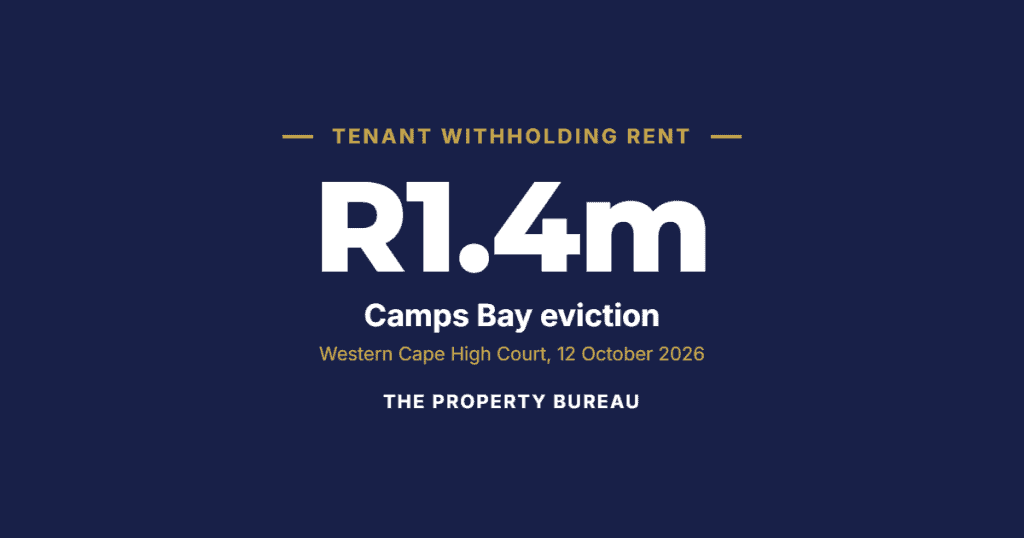
A tenant withholding rent over repairs in South Africa can lose the home: on 12 October 2026 the Western Cape High Court evicted a Camps Bay family.
Costa v N.L.D.C.J and Others [2026] ZAWCHC 596
In Costa v N.L.D.C.J and Others [2026] ZAWCHC 596 the court found that the tenant had withheld R1,407,500 in rent between August 2024 and June 2026 over maintenance complaints. The lease had been cancelled, a claim for a rent reduction had already failed at the Rental Housing Tribunal, and the family must leave by 30 November 2026. Whichever side of a lease you are on, the order in which things were done is the whole story.
In short
- Withholding rent to force repairs is risky, and it failed here.
- Paying the rent into an attorney’s trust account is not paying the landlord.
- Refusing access for repairs undermined the tenant’s own complaint.
- A landlord still needs a court order to evict, and it takes time.
What happened in the Camps Bay case
The tenant had rented the home, on the Atlantic Seaboard, since 2020. From August 2024 she stopped paying the owner, saying the property had not been properly maintained, and paid money into her attorneys’ trust account instead. That account received R393,000. The rent was R60,000 a month, rising to R62,500 from August 2025.
| Date | What happened |
|---|---|
| August 2024 | Rent to the owner stops |
| 4 March 2025 | Written breach notice: seven days to pay R300,000 towards arrears and stop unauthorised subletting |
| 26 March 2025 | Lease cancelled, occupants told to leave by 30 April 2025. They stay |
| 19 August 2026 | Rental Housing Tribunal dismisses the claim for a 30% rent reduction and orders the family to give access |
| 12 October 2026 | Western Cape High Court grants the eviction |
| 30 November 2026 | Deadline to leave. The sheriff may evict from 2 December 2026 |
Why withholding rent failed
-
The money never reached the ownerRent sitting in an attorney’s trust account is not rent paid. From the owner’s side, nothing came in.
-
The repairs could not be assessedThe Tribunal dismissed the rent reduction claim, pointing to the family’s continued use of the home and their failure to give reasonable access to investigate and fix the defects. The court accepted that some problems may exist, but the owner had never been allowed in to see them.
-
The notices were done properlyA breach notice first, then a separate cancellation notice. The court found the cancellation valid.
-
The Consumer Protection Act did not helpThe family argued for the Act’s 20 business days to fix a breach. The court found the owner was a private individual letting one home, not someone letting property in the ordinary course of business, so the Act did not apply.
What the law says about tenant withholding rent
The Rental Housing Act 50 of 1999 gives the landlord the right to prompt and regular payment of rent (section 4(5)(a)) and lets the Rental Housing Tribunal rule against a lack of maintenance (section 13(4)(c)(iv)). Once a tenant lodges a complaint, and until the Tribunal rules or three months pass, whichever is earlier, the landlord may not evict, must do necessary maintenance, and the tenant must keep paying the rent (section 13(7)). The Western Cape Rental Housing Tribunal is free for tenants and landlords. Our guide to the Rental Housing Act covers the rest of the Act.
The common law does give a tenant who loses the use of a property a route to a reduction in rent in appropriate circumstances (Thompson v Scholtz, Supreme Court of Appeal). But where the lease says rent is payable in advance and may not be withheld, the Supreme Court of Appeal has held the tenant could not simply suspend payment (Tudor Hotel Brasserie & Bar v Hencetrade 15, 2017). In practice, a tenant who stays in the home is expected to keep paying and to pursue the repair, or a reduction, through the landlord, the Tribunal or the courts.
On the landlord’s side, a tenant who stays on after a valid cancellation becomes an unlawful occupier under the PIE Act. Only a court can order the eviction (section 8(1)), and after six months of occupation the court must be satisfied it is just and equitable (section 4(7)). Here the court set the date after the eldest child’s Grade 12 exams.
A tenant’s options when repairs are not done, compared
| Option | What happens | Risk to your home |
|---|---|---|
| Keep paying and complain to the Rental Housing Tribunal | Free. For up to three months while it is pending, no eviction and the landlord must do necessary maintenance. The Tribunal can rule on maintenance and on a claim for a rent reduction | Low, as long as you pay and give access |
| Keep paying and take legal advice on a claim | For serious losses. Costs money and time | Low. The cost is the risk |
| Withhold rent | Breach of the lease. The landlord can cancel and apply for eviction | High. This is what failed in Camps Bay |
How to choose: start with the Tribunal. It costs nothing and protects you while it runs. Take legal advice if the loss is serious. Do not hold back the rent.
If you are a tenant: what to do instead of withholding rent
-
Report it in writingWith photos and the date. WhatsApp or email is fine, as long as there is a record.
-
Keep paying the full rentOn time, to the account in your lease.
-
Let them inGive the landlord, the agent and the contractor reasonable access to inspect and repair.
-
Still not fixed? Go to the TribunalLodge a complaint with the Western Cape Rental Housing Tribunal. Contact Centre 0860 106 166.
-
Take advice before touching the rentSpeak to an attorney before you do anything else with it.
Download: Something needs fixing? A guide for tenants (PDF)
If you are a landlord: what to take from it
-
Fix it and record itA request that is logged, answered and dated protects you if a tenant later says it was ignored. See the seven steps every maintenance job goes through.
-
Put arrears in writing earlyA breach notice with a clear deadline, then a separate cancellation notice if it is not remedied. Whether the Consumer Protection Act’s 20 business days apply depends on your circumstances, so check before you cancel.
-
Never take matters into your own handsNo changed locks and no cut services. Only a court can order an eviction.
-
Budget for timeJust over 18 months passed between cancelling this lease and the eviction order.
-
Choose carefully at the startMost of this risk is set on the day you pick the tenant. Here is how I assess a prospective tenant.
Download: When the rent stops. A guide for Cape Town landlords (PDF)
Where a managing agent fits
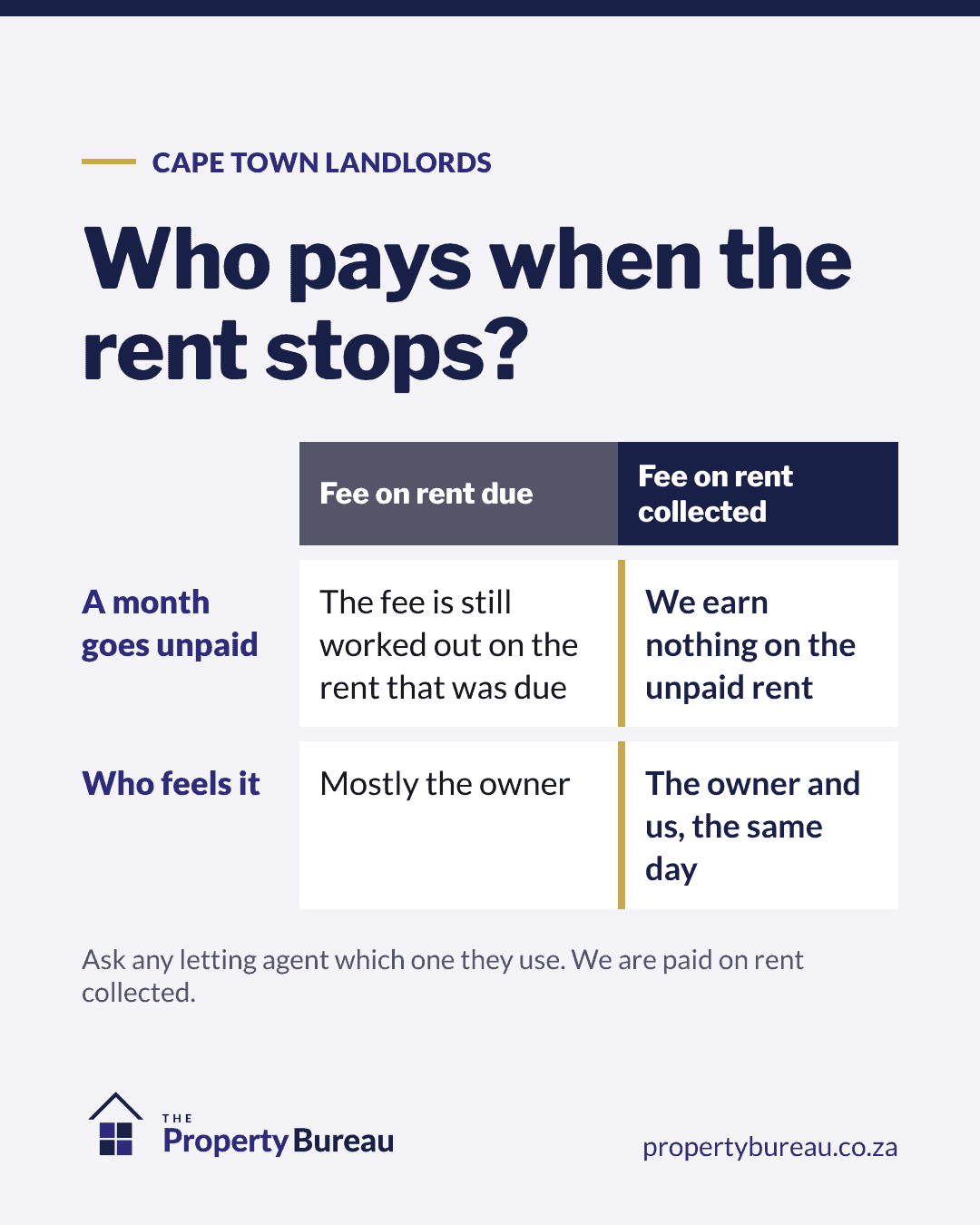
Paid on rent collected. Our management fee is a flat 11.5% of monthly rent collected, fully inclusive, no extras. If the rent does not arrive, we do not earn on it either, so our interests and the owner’s point the same way.
Every repair on record. Each request is logged against the property’s file the day it is reported, the owner decides before anything is instructed, the tenant is told who is coming and when, and the job is closed only with photographs.
Across Cape Town. From the Southern Suburbs to the Atlantic Seaboard and the City Bowl, that record is what you want in hand on the day anyone says a repair was ignored.
That is the lesson in one line: fix it, record it, keep paying, and let the Tribunal and the courts do the arguing.
Frequently asked questions
Can a tenant withhold rent in South Africa if the landlord does not do repairs?
It is risky. The law usually expects a tenant who stays in the home to keep paying and to pursue repairs or a rent reduction through the landlord, the free Rental Housing Tribunal or the courts, and unpaid rent can lead to cancellation and eviction.
Is paying rent into an attorney’s trust account the same as paying the landlord?
No. In the Camps Bay case the owner received nothing, the arrears passed R1.4 million and the court granted the eviction.
Does it cost anything to complain to the Rental Housing Tribunal?
No. In the Western Cape the service is free for tenants and landlords, and while a complaint is pending the tenant must keep paying rent and the landlord may not evict.
Can a landlord evict a tenant for unpaid rent without going to court?
No. Section 8(1) of the PIE Act says nobody may evict an unlawful occupier without a court order, even after the lease has been validly cancelled.
How long does an eviction take in South Africa?
On the rare occasions an eviction has been needed, our experience is that it takes about three to four months from the moment the owner authorises the legal process, provided everything is in order with the lease. Where it drags, it is usually because the owner waits and hopes, and hope wins nothing. Often the prospect of eviction proceedings is enough on its own for a tenant in arrears to pay up or move out. The Camps Bay case took far longer: just over 18 months from cancelling the lease to the eviction order, and 28 months from the first unpaid rent to the move out date. It was contested. The family took a rent reduction claim to the Rental Housing Tribunal and argued the Consumer Protection Act in court, and with children in the home the court had to weigh their needs before setting a date. It set 30 November 2026, after the eldest child’s Grade 12 exams finish.
Own a rental in Cape Town?
Find out what it should earn and how it would be looked after. Ask for a free rental valuation, or read how our property management in Cape Town works.
WhatsApp +27 65 847 5310 | Office 021 797 8850
The Property Bureau. Boutique letting, management and sales in Cape Town since 2007. PPRA registered.
Sources: Costa v N.L.D.C.J and Others [2026] ZAWCHC 596 (12 October 2026), saflii.org; IOL, 14 October 2026; Rental Housing Act 50 of 1999, sections 4 and 13; Prevention of Illegal Eviction from and Unlawful Occupation of Land Act 19 of 1998, sections 4 and 8; Consumer Protection Act 68 of 2008, section 14; Western Cape Government, Rental Housing Tribunal (westerncape.gov.za). All checked 15.10.2026. This article is general information, not legal advice. Reviewed October 2026.
