
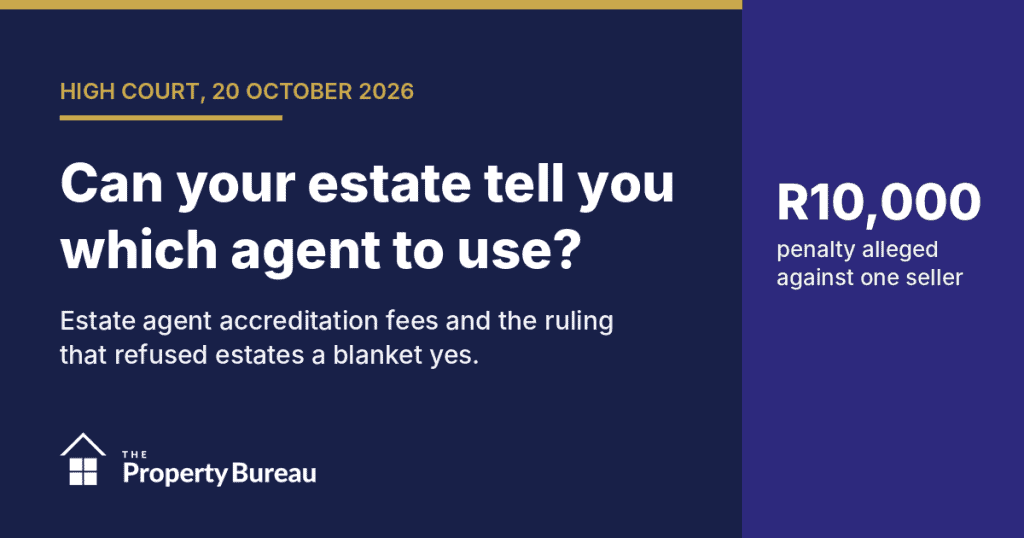
Estate agent accreditation fees charged by estates are not cleared across the board: on 20 October 2026 the High Court refused estates a blanket ruling.
Residential Communities Council (NPC) and Another v Minister of Human Settlements and Others [2026] ZAGPJHC 1208.
I sell and let homes across Cape Town, including in estates and sectional title complexes, so this judgment matters to the owners I work for. It answers part of a question sellers ask more often than you would think: can the estate tell me which agent to use?
In short
- Estates asked the High Court to declare, nationwide, that charging agents a fee before they may market or sell in an estate is not an undesirable business practice. The court said no.
- The fees were not declared unlawful either. Each fee, and each estate, has to be judged on its own facts.
- The judge said the practice can stop sellers and buyers using the agent they trust, and that agents who pay may themselves be in breach.
- If you are selling in an estate or complex and are told which agent to use, ask for it in writing and ask which rule it rests on.
What the estates asked for
The Residential Communities Council, a non profit company that speaks for residential estates, went to court with the Association of Residential Communities. Together they represent some 181 estates. They asked for a declaration that when homeowners’ associations, body corporates and estate governing bodies charge property practitioners a fee before letting them market or sell in the estate, that is not an undesirable business practice under regulation 35 of the Property Practitioners Regulations, 2022.
The estates said the fee pays for things such as induction on the estate rules, security on show days and adverts on the estate website. The Property Practitioners Regulatory Authority (PPRA) opposed the application. The Minister of Human Settlements and the National Property Practitioners Council chose to abide the decision.
What the PPRA told the court
The PPRA put examples before the court. These are the regulator’s allegations, not findings of the court:
- One estate refused to issue clearance figures on a sale because the selling agent had not paid its R5,000 accreditation fee.
- Another charged a private seller a R10,000 penalty for not using an accredited agent. The seller paid it under protest, because the buyer needed transfer to go through.
- Yearly fees to agents range from around R5,000 to R50,000.
The Real Estate Business Owners of South Africa (REBOSA) told the court it has no objection to estates offering paid marketing extras, as long as payment is voluntary and not a condition of being allowed to work in the estate.
What the court decided
Acting Judge Krüger dismissed the application, with costs. The order sought was too broad. To grant it, the court would have had to accept that no estate, homeowners’ association or body corporate in the country falls within the Act’s definition of a property practitioner, and that no fee anywhere crosses the line in regulation 35. The applicants gave no evidence that could carry either point. In the judge’s words, “an application seeking blanket relief is fraught with risk”.
Estate agent accreditation fees and your choice of agent
Two passages in the judgment matter to owners. The first is about choice. The judge said the practice restricts people’s freedom to choose the property practitioner they want to work with. A buyer may find the right home through an agent they trust, only to learn that agent may not show or sell in that estate because the fee was not paid.
The second is about agents. Regulation 35 can be enforced against agents, and the judge said agents who pay the fee may themselves fall foul of it. He described them as “caught between the devil and the deep blue sea”.
What regulation 35 actually says
Regulation 35 names any party that controls or manages a residential property development, “including any body corporate or homeowners’ association”, and lists arrangements it treats as prohibited. In plain terms, these include:
-
Paying for preferenceReceiving money or a reward in exchange for a benefit or preferential treatment in marketing the properties.
-
A designated agent onlyRequiring that a property be sold only through the managing organisation or an agent it designates, or imposing a penalty for not doing so.
-
Favouring some agentsGiving one agent or group of agents an advantage over others in that development.
-
Shutting agents outEffectively excluding or disadvantaging an agent or group of agents from providing services there.
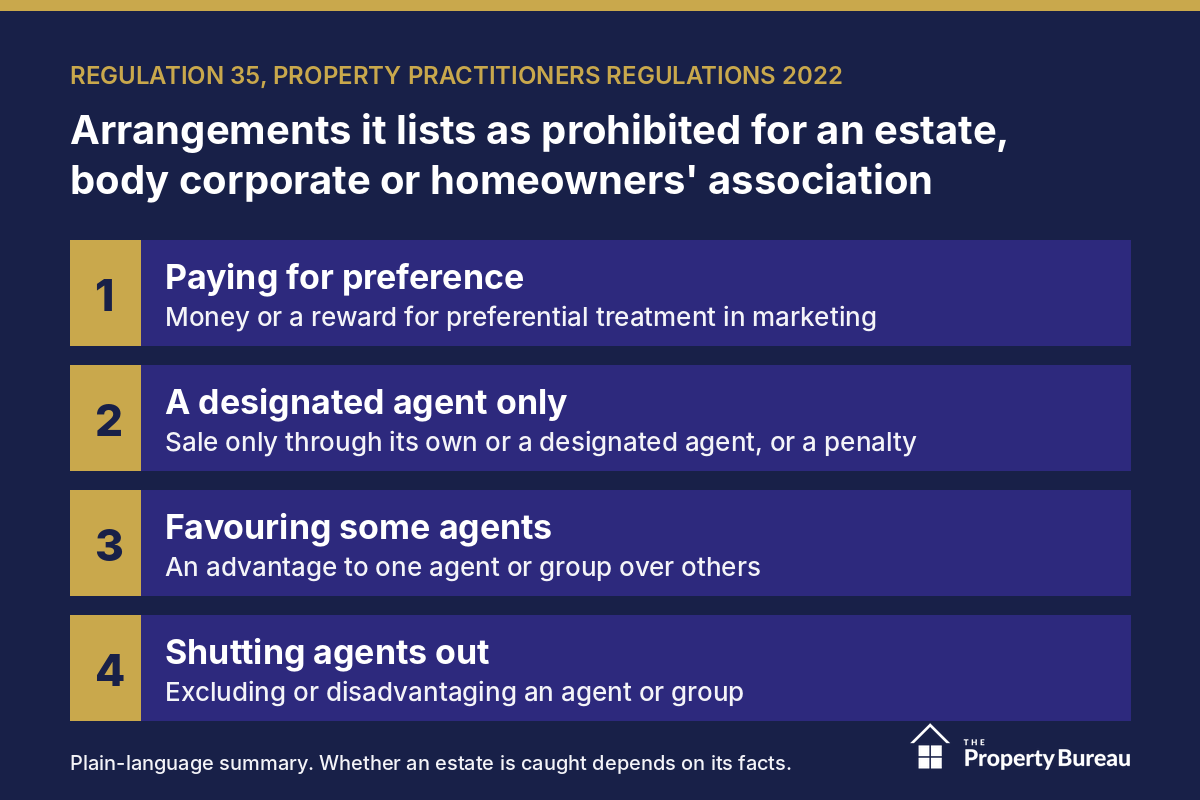
Whether a particular estate is caught still depends on its own facts. That is the point the court left open.
If you are selling in an estate or complex
| What you are asked to pay or do | How I would treat it |
|---|---|
| Register your agent at the gate, follow show day rules, use the estate’s own access process | Normal estate management. Comply. |
| An optional paid advert on the estate website or newsletter | Your choice. REBOSA told the court it has no objection to voluntary extras. |
| Use the estate’s agent, or a listed agent, or the sale will not go ahead | Ask for the rule in writing. Regulation 35 lists this kind of arrangement as prohibited. |
| A penalty because you sold privately or used another agent | Ask for the rule and the amount in writing, and take advice before you pay. |
How to choose: choose your agent first, then tell the estate who it is. Do not let the gate choose for you.
If the property is let, the order of things matters even more. My guide to selling a property you let out in Cape Town covers that.
What the judgment does not decide
It does not say these fees are unlawful. It does not say estates and homeowners’ associations are property practitioners. It refused a blanket answer and left each case to its facts. That matches the PPRA’s position that such fees may, depending on the circumstances, be an undesirable business practice. The judgment is marked not reportable, so it is a signal of how a court approaches the question, not the last word.
That is the whole point in one line: an estate can run its gate, but the choice of agent should stay with the owner.
Frequently asked questions
Can my estate or body corporate make me use its agent?
Regulation 35 of the Property Practitioners Regulations, 2022 lists as prohibited an arrangement where a body corporate or homeowners' association requires a property to be sold only through its own or a designated agent, or penalises an owner who does not. The October 2026 judgment did not decide whether every estate falls under the Act, so ask for the rule in writing.
Are estate agent accreditation fees illegal?
Not across the board. On 20 October 2026 the High Court in Johannesburg refused to declare them acceptable everywhere and said each fee has to be judged on its own facts.
What should I do if my estate charges me a penalty for my choice of agent?
Ask for the rule and the amount in writing, and take advice before you pay. If you have to pay to keep a transfer moving, pay under protest and keep the paperwork.
Does this affect buyers too?
Yes. The judge said the practice can stop a buyer using the agent they trust, because an agent who has not paid an estate's fee may not be allowed to show or sell property there.
Selling in an estate or complex in Cape Town?
Get an honest number first. Ask for a free written valuation, or read how we sell property in Cape Town.
WhatsApp +27 65 847 5310 | Office 021 797 8850
The Property Bureau. Boutique letting, management and sales in Cape Town since 2007. PPRA registered.
Sources: Residential Communities Council (NPC) and Another v Minister of Human Settlements and Others (2024/111832) [2026] ZAGPJHC 1208, Gauteng Local Division, Johannesburg, 20 October 2026 (SAFLII); SAnews, 21 October 2026; Property Practitioners Regulations, 2022, regulation 35, as quoted in the judgment. Reviewed 30 October 2026. General information, not legal advice.
Paul Grobler, Principal, The Property Bureau, Cape Town. PPRA registered.
Get new articles by email
Letters from The Property Bureau is a free email letter for Cape Town landlords, written by Paul Grobler. Subscribe on Substack.
