
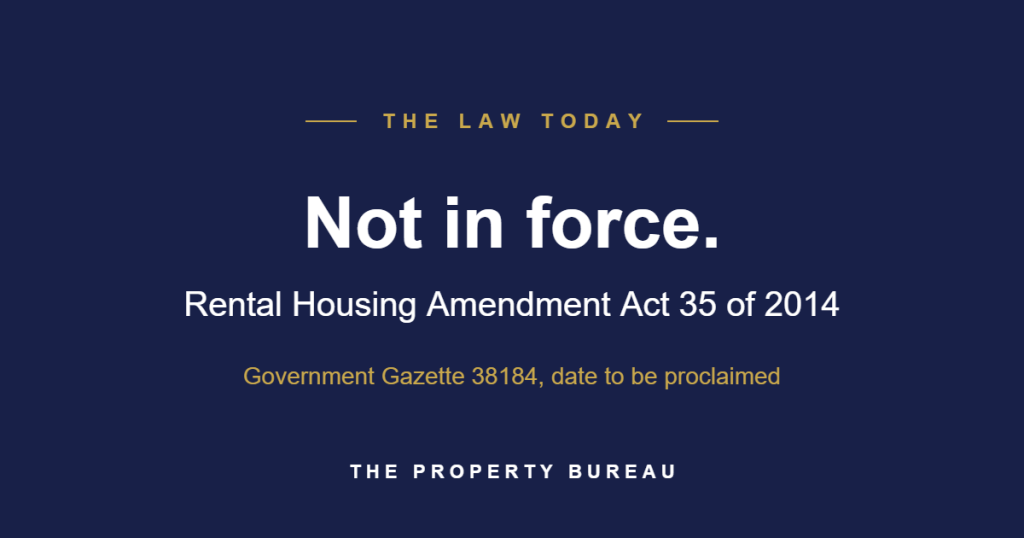
No. The Rental Housing Amendment Act 35 of 2014 was signed and published, but no commencement date has been proclaimed. The law in force is the 1999 Act as amended in 2007.
Government Gazette 38184 of 5 November 2014, “with effect from date to be proclaimed”
Search for the Rental Housing Act and half the pages you find quote the 2014 amendments as if they were law. Compulsory written leases, a Tribunal in every province, appeals to the MEC. None of that is in force yet. Here is the position, and what it means for your lease.
In short
- Act 35 of 2014 is not in force. It waits for a proclamation by the President.
- The law today is the Rental Housing Act 50 of 1999, as amended by Act 43 of 2007.
- A lease still need not be in writing, but the landlord must put it in writing if the tenant asks.
- Rental Housing Tribunals already exist, including in the Western Cape.
Is the Rental Housing Amendment Act 35 of 2014 in force?
No. The Amendment Act was published in Government Gazette 38184 on 5 November 2014, to take effect from a date to be proclaimed. That proclamation has not been made. The consolidated text on SAFLII, last reviewed for updates on 5 December 2025, still marks every 2014 change as uncommenced, and we found no proclamation when we checked on 3 November 2026.
That is why the date 5 November 2014 causes confusion. It is the date the Act was published, not the date it started. Some articles treat the two as the same.
An Act that has been passed but not commenced is not law. Nobody can be held to it, and no Tribunal can rule on it.
What the law in force says
The Rental Housing Act 50 of 1999 took effect on 1 August 2000. The Rental Housing Amendment Act 43 of 2007 came into force on 13 May 2008. Together they are the rules that apply to every residential lease today. The points people most often get wrong:
| Topic | In force now | Proposed in 2014, not in force |
|---|---|---|
| Written lease | Need not be in writing, but must be put in writing if the tenant asks (section 5(1) and (2)) | Every lease must be in writing |
| Rental Housing Tribunals | Provinces may establish them. The Western Cape has one. | Every province must establish one |
| Information offices | Not compulsory | Every local municipality must establish a Rental Housing Information Office |
| Appeals | Review by the High Court | Appeal to the MEC within 14 days of a Tribunal decision |
| Wording | “Landlord” and “local authority” | “Landowner” and “local municipality” |
The deposit rules, the joint inspections, the interest on the deposit and the refund deadlines are all in the Act already, in section 5(3), and they apply now. Our guide to the Rental Housing Act covers them in full.
What it means for you
-
TenantsYour rights come from the 1999 Act and your lease. Ask for the lease in writing, which the landlord must do on request, and insist on the joint inspection before you move in.
-
LandlordsDo not wait for the 2014 Act to put a lease in writing. A written lease and a signed inspection report are what protect you in front of a Tribunal. Our guide to a landlord’s legal obligations lists what applies today.
-
Anyone quoting the lawCheck the source. If a page cites section 4A or 4B, or says leases must be in writing, it is quoting the uncommenced 2014 text.
We will update this page when a commencement date is proclaimed.
For landlords
Every lease we sign is in writing, with a joint incoming and outgoing inspection and the deposit held in an interest bearing account, because that is what the Act in force requires and what works in a dispute. See how our Cape Town property management works, or our landlord services.
That is the rule in one line: published in 2014, never commenced, so the 1999 Act as amended in 2007 is the law.
Frequently asked questions
Is the Rental Housing Amendment Act 35 of 2014 in force?
No. It was published on 5 November 2014 to take effect from a date to be proclaimed, and no commencement date has been proclaimed. The law in force is the Rental Housing Act 50 of 1999 as amended by Act 43 of 2007.
Does a lease have to be in writing in South Africa?
Not under the Act in force. A lease need not be in writing, but the landlord must put it in writing if the tenant asks. The 2014 Amendment Act would make written leases compulsory, but it has not commenced.
Which version of the Rental Housing Act applies?
The Rental Housing Act 50 of 1999, in force from 1 August 2000, as amended by the Rental Housing Amendment Act 43 of 2007, in force from 13 May 2008.
Own a rental in Cape Town?
Find out what it should earn and how it would be looked after. Ask for a free rental valuation, or read how our property management in Cape Town works.
WhatsApp +27 65 847 5310 | Office 021 797 8850
The Property Bureau. Boutique letting, management and sales in Cape Town since 2007. PPRA registered.
Sources: Rental Housing Act 50 of 1999, consolidated text with uncommenced amendments, saflii.org (last checked by SAFLII 5 December 2025); Rental Housing Amendment Act 35 of 2014, Government Gazette 38184 of 5 November 2014; Rental Housing Amendment Act 43 of 2007, in force from 13 May 2008. Checked 03.11.2026. This article is general information, not legal advice. Reviewed November 2026.
Get new articles by email
Letters from The Property Bureau is a free email letter for Cape Town landlords, written by Paul Grobler. Subscribe on Substack.
