
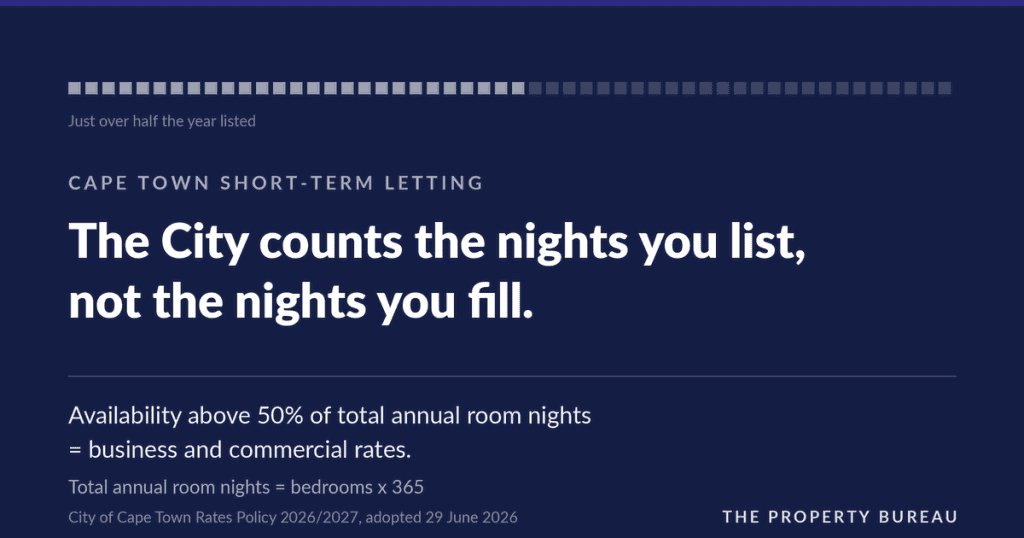
Cape Town short-term letting will be rated as commercial where availability passes 50%, and the test counts the nights you list, not the nights you fill.
That distinction is the single most expensive misunderstanding in this change. Most owners working out whether the rule catches them are counting bookings. The City is not measuring how often your property is let. It is measuring how often it is available.
In short
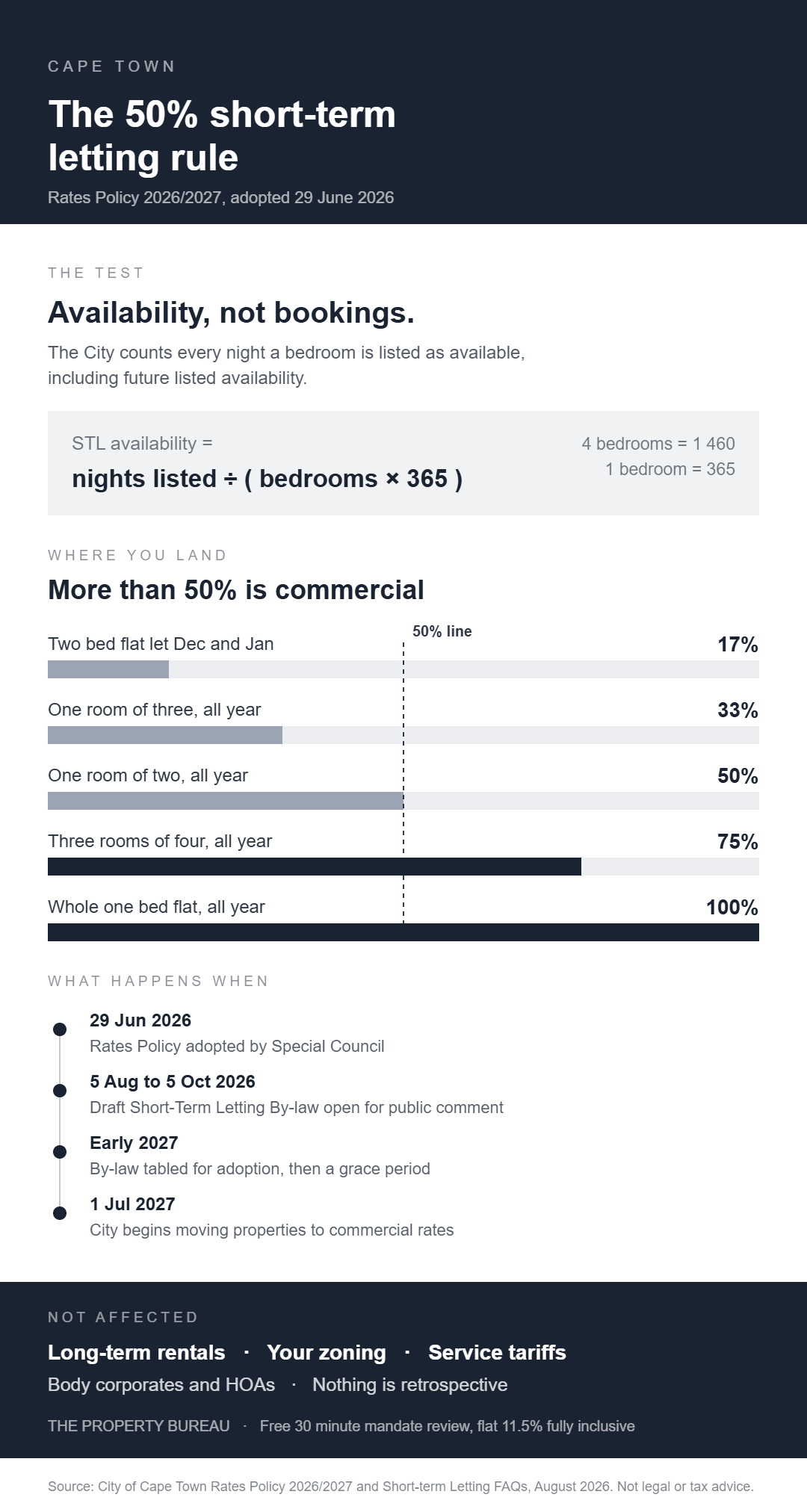
- Cape Town’s Rates Policy 2026/2027 was adopted on 29 June 2026. It categorises a property as business and commercial where short-term letting availability exceeds 50% of total annual room nights.
- Total annual room nights is your number of bedrooms multiplied by 365.
- The measure is nights listed as available on a booking platform, not nights booked.
- The draft Short-Term Letting By-law, which creates the registration and data-sharing system, is open for public comment from 5 August to 5 October 2026.
- Rating changes are only foreseen from 1 July 2027, and they are not retrospective.
- Long-term rentals are not affected.
The policy is settled. The by-law is not.
These are two separate documents and it is worth keeping them apart, because a lot of the commentary runs them together.
The Rates Policy 2026/2027 was approved by Special Council on 29 June 2026. It is live policy. It contains the definitions and the 50% threshold. You can read it in full in the City of Cape Town Rates Policy 2026/2027, where short-term letting is dealt with at clause 4.5.
The draft Short-Term Letting By-law is the machinery. It creates the registration system and obliges the booking platforms to share data, which is what allows the City to apply the policy in practice. It is open for public comment from 5 August to 5 October 2026, after which the City intends to table it for adoption by Council early in 2027.
So the rule exists, and the means of enforcing it is what is still being consulted on. If you want to say something about it, this is the window.
How the 50% is worked out
The calculation in the Rates Policy is straightforward once you see it.
Total annual room nights is the number of bedrooms in the property multiplied by 365. A one-bedroom apartment has 365. A four-bedroom house has 1 460.
Short-term letting availability is the sum of every night each bedroom is listed as available, added across all the rooms.
Divide the second by the first. Above 50% and the property is categorised as business and commercial.
The City’s own worked examples make the shape of it clear:
- A couple who let their two-bedroom apartment for December and January, 62 nights per room. That is 124 divided by 730, or 17%. Residential.
- A family letting a one-bedroom cottage beside their three-bedroom house, all year. That is 365 divided by 1 460, or 25%. Residential.
- A retiree letting one spare bedroom in a two-bedroom flat, all year. That is 365 divided by 730, exactly 50%. Still residential, because the threshold is more than 50%.
- An owner letting a whole one-bedroom apartment all year. That is 100%. Commercial.
- A homeowner living in a four-bedroom house who lets the other three rooms all year. That is 1 095 divided by 1 460, or 75%. Commercial.
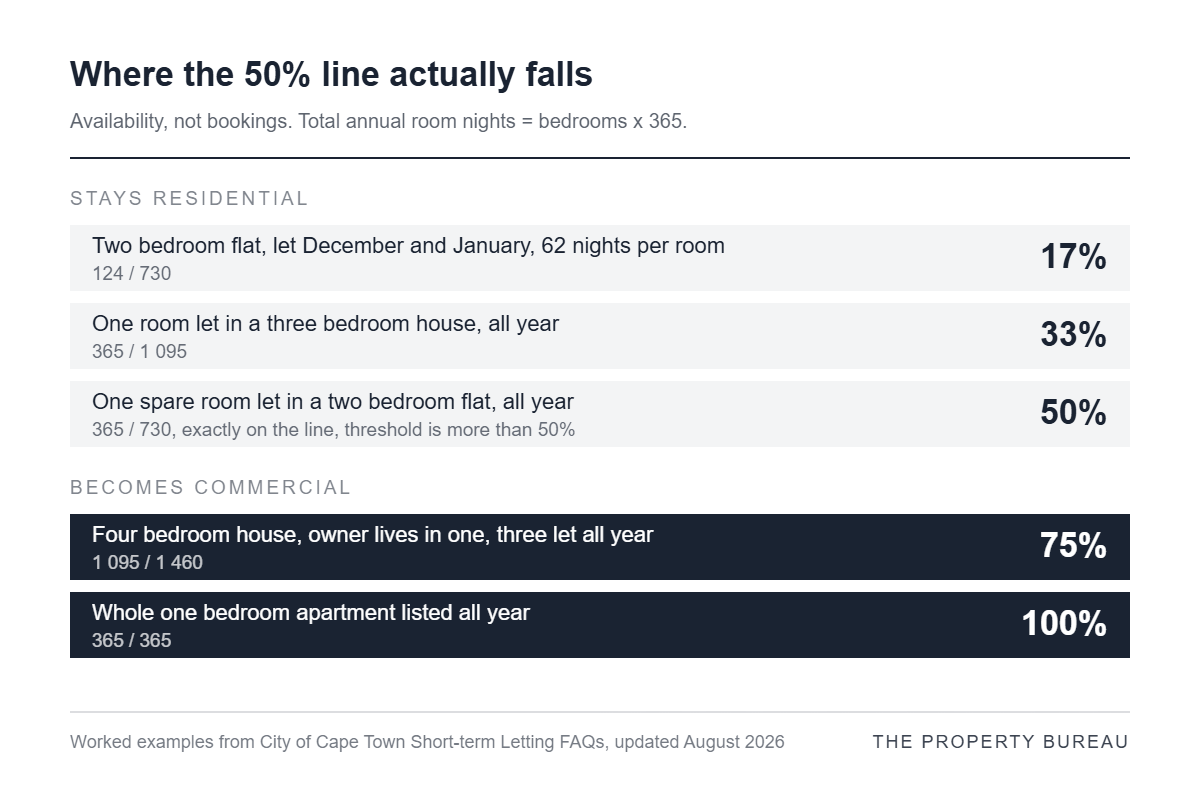
Note where the line actually falls. Letting a room or a cottage is not what catches people. Listing most of the property for most of the year is.
Which means the rule lands very differently depending on where in Cape Town your property sits, and it is worth being honest about that rather than pretending it is uniform.
Across the Atlantic Seaboard, from Green Point and Three Anchor Bay through Mouille Point, Sea Point, Bantry Bay and Clifton to Camps Bay, Bakoven and Hout Bay, and through the City Bowl and CBD, including De Waterkant, Gardens, Tamboerskloof and the converted apartment stock around the foreshore, the dominant pattern is a whole apartment listed year round. That is the profile most likely to be over the threshold, often at or near 100%. If you own there and the calendar stays open, assume you are affected and check rather than hope.
Through the Southern Suburbs, in Constantia, Bishopscourt, Newlands, Rondebosch, Claremont, Kenilworth, Wynberg, Bergvliet and Tokai, it is more often a garden cottage, a granny flat or a self-contained flatlet let alongside a family home that remains a primary residence. On the City’s own arithmetic those usually sit well under 50%. A one bedroom cottage next to a three bedroom house is 25%.
Along False Bay and the South Peninsula, from Muizenberg and Kalk Bay through Fish Hoek, Glencairn and Simon’s Town, and over to Noordhoek and Kommetjie, it splits. Holiday stock listed through the season and beyond behaves like the Atlantic Seaboard. A family home let for a few weeks over December behaves like the Southern Suburbs.
The point is not the suburb. It is what proportion of the property you leave listed, and for how long. But the suburb is a fair guide to which side of the line you are likely to be on before you do the sum.
What counts as one property
The calculation runs across a whole property, not across each letting unit, and that is what catches owners with a cottage or a granny flat.
A freehold property is categorised in its entirety. Where a main house and a garden cottage sit on one erf, the City applies the total annual room nights calculation across both together. If the combined short-term letting activity goes over the threshold, the whole property is categorised as commercial, main house included. If it stays under, the whole property stays residential.
Sectional title works the other way. Each unit is assessed on its own. A scheme is not judged collectively, so one owner in a block letting year round does not drag the rest of the building over the line, and equally gains nothing from neighbours who let nothing at all.
For most Southern Suburbs owners this is reassuring rather than alarming. A one bedroom cottage beside a three bedroom house is 25% even with the calendar open all year, because the sum already counts all four bedrooms. The owners who need to look carefully are those with a large letting unit against a small main house, where the ratio sits closer to the line than they expect.
Cape Town short-term letting is measured on availability, not occupancy
This is the part worth reading twice.
The City measures listing availability on the booking platform rather than nights actually booked. Its stated reason is that availability reflects the owner’s intention to use the property commercially, whether or not a booking follows.
The practical consequence: a calendar left open through a quiet winter still counts. A bad season does not help you. You can have a thin year commercially and still sit above the threshold, because nobody is looking at whether the guests came.
It is also assessed on a rolling basis. The City will look at any 365-day period, and once a property is found to have been listed more than 50% of the time, the change goes through in the next supplementary valuation, which usually happens every two months. The categorisation is effective from the date the threshold was crossed, and it stays until availability falls back below 50% within a 365-day period.
What the by-law would require
Under the draft, any property advertised on a booking platform must obtain a City-issued short-term letting registration number and display it on every listing. That includes houses and apartments, and also hotels, guesthouses and B&Bs.
Booking platforms would be required to remove listings that do not display a valid number, and to share availability and occupancy data for registered properties.
Properties can be de-registered. If a listing comes down, the owner tells the City and the number is disabled.
What does not change
Several things people assume are affected are not.
Long-term rentals. A home let on a long-term lease stays residential, because it remains the tenant’s primary place of residence. The City states this directly, and gives it as a worked example. The same applies where a homeowner lets two of three bedrooms on long-term leases.
Zoning. No zoning change is required or proposed. The Municipal Planning By-law already permits short-term letting.
Service tariffs. No change.
Retrospective rates. Category changes are only foreseen from 1 July 2027, applied through the supplementary valuation process from the date the threshold is crossed.
Body corporates and HOAs. Not affected by the change. They set their own rules on short-term letting within their buildings and the City does not regulate that.
One detail worth knowing if you let your own home
There is a smaller provision that sits alongside the main rule. The Rates Policy grants a reduction of R605 000 in market value to owners of residential property used as a primary place of residence and valued below R8 000 001. Clause 9.3 provides that a property used or available for short-term letting for more than 50% of total annual room nights does not qualify for that relief.
In practice this affects a narrow group. A second home or a pure investment short-let never qualified for the reduction in the first place, and a property over the threshold is being recategorised as commercial in any event. It matters if you heavily short-let the home you actually live in and the property is under R8m. I mention it because it is in the policy and it is being misreported elsewhere as a large second penalty. It is not.
Where this leaves an owner weighing it up
I am not going to tell anyone to stop short letting. Plenty of properties earn their keep that way, the City has said explicitly that it does not want to restrict the activity, and its stated purpose is fairness on rates rather than suppression of the sector.
But the arithmetic is changing for one particular owner: the person running a property that is listed most of the year, who has been paying residential rates on what is functionally an accommodation business. From July 2027 that is a commercial rate, and it needs to go into the model now rather than in eighteen months.
If that is you, there are three sensible things to do. Work out your actual availability percentage on the right formula. Comment before 5 October if the rule affects you. And if the numbers no longer work, compare them honestly against a managed long-term tenancy, which sits outside all of this.
That is the whole thing in one line: the City is counting the nights you offer, not the nights you fill.
Talk it through
If you are weighing a short-let against a long-term tenancy on a Cape Town property, I am happy to run the comparison with you. We let and manage residential property across the peninsula at a flat 11.5% of monthly rent collected, fully inclusive, with no extras, and the mandate review is a free half hour with me directly.
This article summarises published City of Cape Town policy and a draft by-law. It is not legal, tax or financial advice, and the by-law is not yet adopted.
Frequently asked questions
Does the 50% rule count nights I actually let?
No. It counts nights each bedroom is listed as available on a booking platform, added across all rooms, divided by bedrooms multiplied by 365.
I let one room in my house all year. Am I caught?
Not on those facts. One room in a three-bedroom house listed for a full year is 33%, which is below the threshold.
When does this start?
Rating category changes are only foreseen from 1 July 2027, after the by-law is adopted and a grace period has run. The comment period on the draft by-law closes on 5 October 2026.
Will I be charged commercial rates for past years?
No. The changes are not retrospective. They apply from the date the threshold is crossed, from 1 July 2027 onwards.
I rent my property out on a long lease. Does this affect me?
No. Long-term rentals remain residential, because the property is the tenant’s primary place of residence.
I have a granny flat. Is it assessed separately?
No. On a freehold property the City applies the calculation across the whole property, so the cottage and the main house are counted together. Sectional title units are assessed one by one.
Paul Grobler is the owner and principal of The Property Bureau, an owner-run letting and management agency in Wynberg, Cape Town, working across the Southern Suburbs, False Bay and the Atlantic Seaboard since 2007. He is a registered Property Practitioner.
Sources, both City of Cape Town, accessed 5 August 2026: Annexure 5, Rates Policy 2026/2027, approved by Special Council 29 June 2026; and Short-term Letting in the City of Cape Town, Frequently Asked Questions, updated August 2026.
